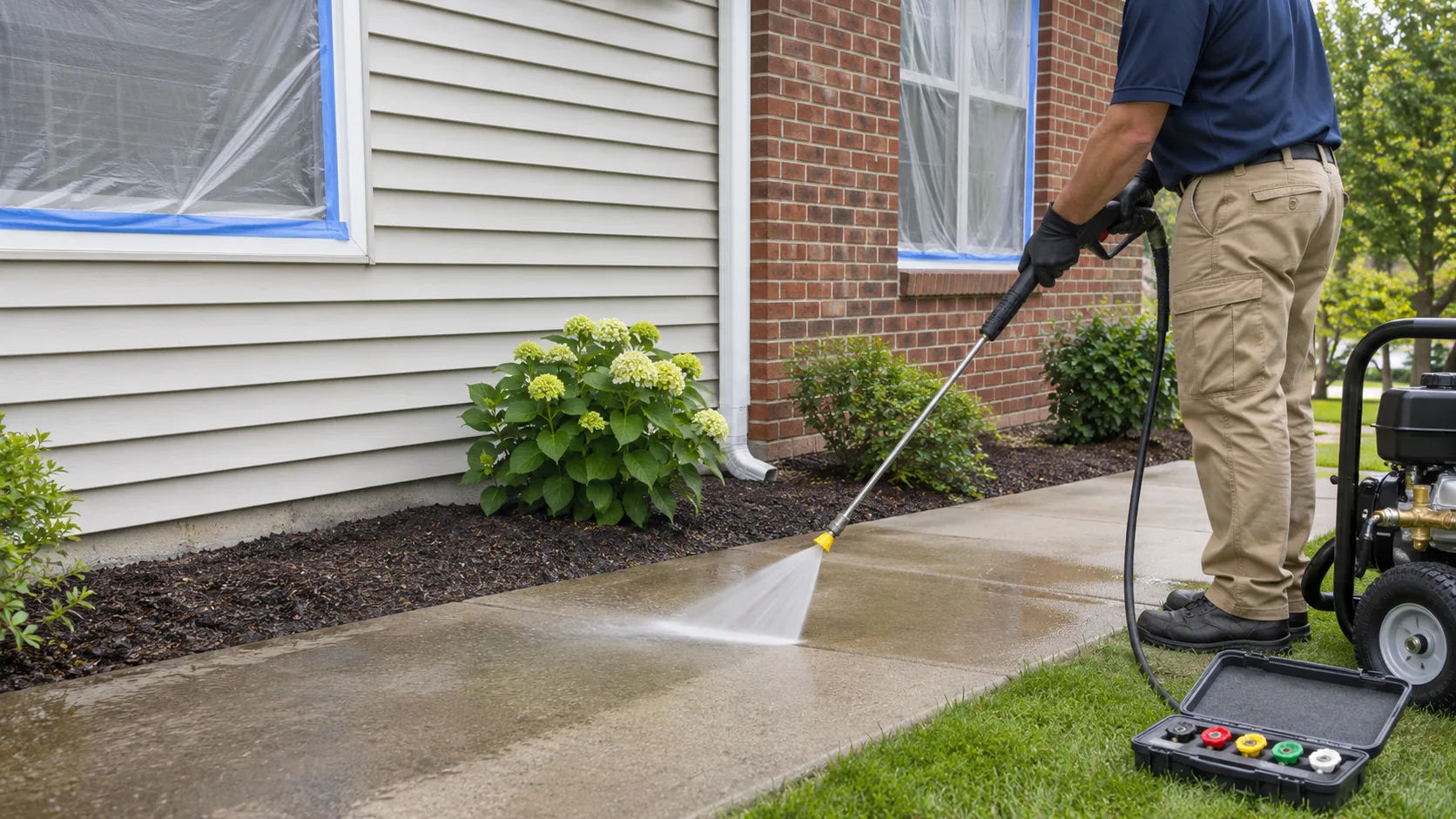
Can Pressure Washing Damage Vinyl Siding, Brick, or Concrete?
Yes. A pressure washer is a cutting tool when it is misused, and every common exterior material in Missouri has a point where the water does more harm than good. The damage usually comes from three things: too much pressure, a nozzle that concentrates the stream into a narrow jet, and holding the wand too close to the surface. HomeAdvisor notes that a 40-degree nozzle is generally considered safe for siding, while a 0-degree nozzle can strip paint. Consumer Reports, in an August 2026 guide, warns that brick and stone can be etched, aluminum siding can dent, and roof shingles can be loosened or damaged. The good news is that each material has a safe way to clean it. Vinyl and brick respond well to low-pressure soft washing, and concrete can take higher pressure when the right equipment and technique are used.
How Does High-Pressure Washing Damage Vinyl Siding?
Vinyl siding is designed to shed water that runs down its face, not water blasted up underneath it. The Polymeric Exterior Products Association, which now hosts the vinyl siding industry's care guidance, advises keeping a power washer wand level at about eye height and warns not to aim the stream upward, because that can force water behind the siding panels. Trapped water can soak sheathing and insulation and lead to hidden moisture problems. The same guidance notes that some siding manufacturers do not allow power washing at all, others set limits on pressure and cleaners, and many advise avoiding windows, doors, electrical wiring, and plumbing. High pressure can also crack brittle older panels or knock them loose at the locks. That is why we clean vinyl with low-pressure soft washing, as explained in our guide to pressure washing vs. soft washing in Missouri.
What PSI Is Safe for Cleaning Brick Homes in Missouri?
The Brick Industry Association, in Technical Note 20 on cleaning brickwork, advises against water pressure higher than 400 psi at the nozzle tip unless the brick manufacturer approves more, and it states that high pressure above 800 psi is not appropriate for brick. Excessive pressure, according to the note, can damage brick faces, erode mortar joints, and remove coatings. That matters across Missouri, where many St. Louis neighborhoods are lined with century-old brick homes whose softer mortar is especially easy to wash out. Brick cleaning should start with a small trial area, be pre-wet with very low pressure, and use a wide fan tip held well back from the wall. Once mortar is gouged, the fix is tuckpointing, not cleaning, so a gentle approach costs far less in the long run.
• Stay at or below 400 psi at the nozzle unless the manufacturer allows more
• Use a 25 to 50 degree fan tip
• Hold the nozzle at least 12 inches from the brick
• Pre-wet the wall at under 100 psi and keep it wet until the final rinse
• Test about 20 square feet first and let it dry before judging
Can Pressure Washing Damage Concrete Driveways and Patios in Missouri?
It can, although concrete is the most forgiving of the three materials. Angi's pressure guide lists roughly 3,000 to 4,000 psi as a typical range for concrete hardscaping, but pressure alone does not tell the whole story. A narrow tip held a few inches away can etch the surface paste, expose aggregate, and leave visible wand marks that look worse than the stain did. Uneven passes leave light and dark stripes. New concrete needs extra care, and concrete supplier guidance recommends waiting about 28 days after placement before sealing, letting a washed slab dry at least 72 hours before sealer goes on, and avoiding deicing chemicals during the first winter. Missouri freeze and thaw cycles are hard on concrete that has lost its surface, so professionals use rotary surface cleaners for even results, then rinse and treat oil or rust stains separately.
Which Exterior Surfaces Should Never Be Cleaned With High Pressure?
Several surfaces on a typical Missouri home should only be cleaned with low pressure or by hand. Asphalt shingle roofs are at the top of the list, because a pressure washer can strip protective granules and loosen shingles, which is why roof cleaning is done with a soft wash method. Windows are another, since a strong jet can break seals on insulated glass, damage screens, and push water past frames. Stucco, painted wood, and older aluminum siding can be gouged, peeled, or dented. Soft, historic brick and old mortar fall into the same group. Even outdoor electrical fixtures, meters, and HVAC fins can be bent or flooded by a direct jet. For all of these, the safer approach is a cleaning solution that loosens dirt and organic growth, followed by a gentle rinse that carries it away.
• Asphalt shingle roofs
• Window glass, seals, and screens
• Stucco and painted wood
• Aluminum siding
• Historic brick and soft mortar
• Electrical fixtures, meters, and HVAC units
How Do Professionals Pressure Wash Safely in Missouri?
Safe exterior cleaning starts with identifying each material before any water is sprayed. A professional crew walks the property, notes siding type, brick age, concrete condition, and any loose trim or failing caulk, and then chooses a method for each surface. Siding, brick, and stucco get low-pressure soft washing, where a cleaning solution does the work and the rinse is gentle. Concrete gets controlled pressure through a rotary surface cleaner so passes are even. Trial spots are cleaned first on brick and older surfaces. Plants are pre-wet and rinsed, outlets and fixtures are protected, and runoff is managed rather than hosed into storm drains. Windows are cleaned last with pure deionized water so overspray does not leave spots. Our crews are fully insured, uniformed, and background-checked, and every quote is fixed before work begins.
How Can Andy's Window Cleaning Help With Safe Pressure Washing in Missouri?
Andy's Window Cleaning cleans Missouri exteriors with the method each surface calls for, using low-pressure soft washing for vinyl siding, brick, stucco, and roofs, and controlled pressure for driveways, walks, and patios. We serve homes and businesses across St. Louis, St. Charles, Columbia, Jefferson City, Lake of the Ozarks, Springfield, and Rolla, and we can bundle house washing, roof cleaning, gutter cleaning, pressure washing, and window cleaning into one visit for one combined price. Readers of Missouri Best Magazine voted us Missouri's Best Window Cleaning Company in 2023, 2024, and 2025, and every job is backed by our guarantee, "Done Right, or We Make It Right!" St. Louis area homeowners can visit our St. Louis window cleaning page or call 314-494-4444. Tell us what surfaces you have, and we will send a free fixed quote with the method we plan to use on each one.
Frequently Asked Questions About Safe Pressure Washing
There is no single number that suits every brand, which is why the industry's care guidance says to check the siding manufacturer's instructions first. Some manufacturers prohibit power washing, and others set pressure limits. Low-pressure soft washing with a cleaning solution is the safest option, and any spray should be aimed level, never upward under the panels.
Yes. The Brick Industry Association warns that excessive pressure can erode mortar joints and damage brick faces, and it advises staying at or below 400 psi at the nozzle unless the brick manufacturer approves more. Older homes with soft lime mortar are especially vulnerable, so a trial area and a wide fan tip are essential.
Stripes usually come from uneven passes with a handheld wand, where some areas get more pressure or dwell time than others. Holding the tip too close can also etch the surface. Professionals use rotary surface cleaners that spin at a fixed height above the slab, which produces a more even finish across the whole driveway.
Give new concrete time to cure before any aggressive cleaning. Concrete supplier guidance recommends about 28 days after placement before sealing and suggests avoiding deicing chemicals during the first winter. When in doubt, ask the installer, start with a garden hose, and save higher pressure for a fully cured slab.
Soft washing is the method used for asphalt shingle roofs because high pressure can strip granules and loosen shingles. A cleaning solution is applied at low pressure to kill and loosen algae, lichen, and moss, and then gently rinsed. Roof work also involves fall risk, so it is best left to an insured crew.
It can. Spraying upward under siding laps, directly into window frames, or at door thresholds can push water into walls and sheathing, where it may not dry quickly. The EPA notes that mold needs moisture to grow, so keeping water out of wall cavities matters. Aim level, stay back from openings, and use low pressure on walls.