What Is the Difference Between Pressure Washing and Soft Washing?
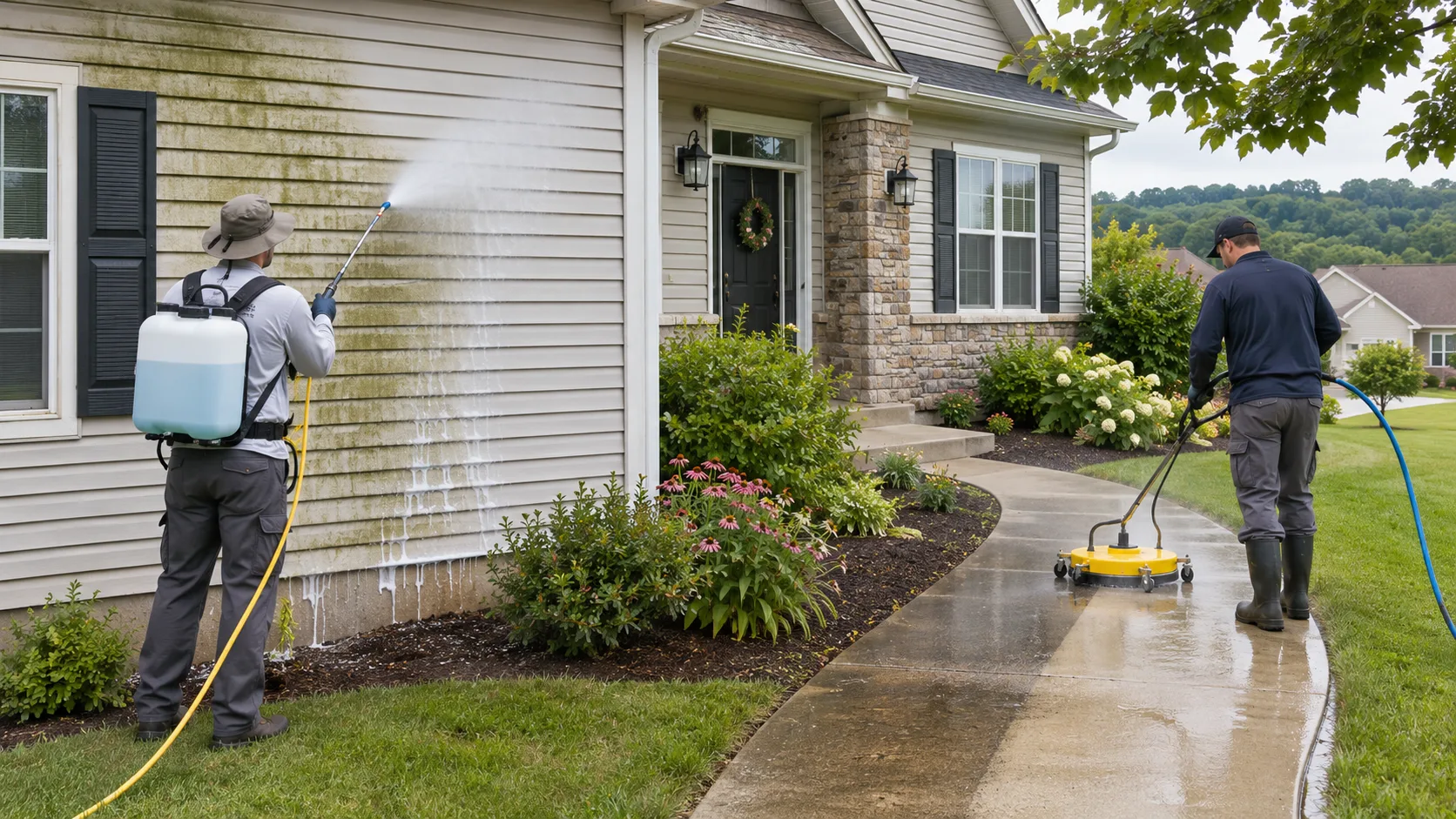
The difference is pressure and how the dirt comes off. Pressure washing uses a high-pressure stream of water to strip grime from hard surfaces. Angi lists typical pressure washing at about 1,300 to 3,100 PSI, and HomeGuide notes that a garden hose delivers only about 50 PSI for comparison. Soft washing uses low pressure, with tips that drop output to roughly 150 to 300 PSI according to Angi, and Fixr's 2025 cost guide defines it as washing set to less than 500 PSI. Instead of force, soft washing relies on a cleaning solution that is applied, given time to work, and then rinsed away. That solution breaks down algae, mildew, and organic staining, so the surface gets clean without the blasting that can etch, scar, or loosen building materials. Both methods use similar equipment, but they are set up for very different jobs.
Which Method Is Better for Vinyl Siding on Missouri Homes?
Soft washing is the safer choice for vinyl siding on most Missouri homes. Vinyl panels are designed to overlap and shed water downward, and a high-pressure stream can push water behind them. The Vinyl Siding Institute's cleaning guidance says a power washer can be used with caution, warns against aiming the stream upward because it can force water behind the panels, and notes that some manufacturers do not recommend power washing at all, while others limit pressure and cleaners. Trapped moisture behind siding can lead to mildew, staining, and problems with the sheathing underneath. Soft washing avoids that risk because the cleaning solution does the work at low pressure. It also reaches the green film that collects in the grooves of textured panels, which a quick pressure rinse tends to leave behind, so the siding looks cleaner and stays clean longer.
Is Soft Washing Safer for Brick, Stucco, and Painted Surfaces?
Yes. Brick, mortar, stucco, and paint are softer and more porous than they look, and high pressure can erode them. The Brick Industry Association's Technical Note 20, updated in 2018, says not to use water pressures higher than 400 PSI at the nozzle tip unless the brick manufacturer allows it. The same note calls for a 25 to 50 degree fan tip held at least 12 inches from the brick. Many consumer pressure washers run well above that limit. Stucco can crack or absorb water when it is blasted, and painted siding or trim can peel. Soft washing keeps pressure low and lets the cleaning solution lift algae, mildew, and dirt, which protects the finish while still removing the growth that makes these surfaces look dingy.
• Brick and mortar: no more than 400 PSI at the tip per BIA guidance
• Stucco: low pressure to avoid cracking and water absorption
• Painted wood and trim: low pressure to avoid peeling
• Vinyl siding: no upward spray, per Vinyl Siding Institute guidance
Why Do Missouri Homes Grow So Much Algae and Mildew on Siding?
Missouri's climate is wet and humid enough to keep organic growth active for much of the year. The 2025 NOAA State Climate Summary for Missouri reports a long-term statewide average of 41.1 inches of precipitation a year, with totals near or above average since the 1990s. It also notes that summer humidity has risen since the mid-1900s, and that very warm nights at St. Louis increased from 13 per year in 1961 to 1990 to 20 per year in 1991 to 2024. Warm, damp nights are ideal for algae and mildew. Shaded north and east walls, siding near trees, and surfaces close to sprinklers turn green first. Our crews see this every season on homes we serve for window cleaning in St. Louis and across the state. Soft washing treats that growth directly, so it comes back more slowly than when it is simply blasted off.
When Is Pressure Washing the Right Choice for Missouri Properties?
Pressure washing is the right choice for hard, durable surfaces that can take the force. Concrete driveways, sidewalks, patios, entryways, and stone pathways are the main candidates. Angi notes that concrete is the only surface that should get full-strength washing of about 4,000 PSI, and then only with a surface cleaner attachment that spreads the pressure evenly. HomeGuide's cost guide rates heavy-duty machines above 2,800 PSI for driveway and sidewalk stains. In Missouri, concrete collects mildew, tire marks, leaf tannins, and freeze-thaw grime, and a controlled pressure wash lifts all of it. Treated wooden decks can also be pressure washed, but at lower settings, because too much pressure raises the grain and gouges the boards. The key is matching the pressure to the surface rather than using one setting for the whole property.
• Concrete driveways and garage aprons
• Sidewalks, walkways, and entryways
• Concrete and stone patios
• Treated wooden decks, at reduced pressure
Should You Soft Wash or Pressure Wash a Roof?
Roofs should be soft washed, never pressure washed. The Asphalt Roofing Manufacturers Association says not to use a power washer or any type of brush or broom to clean algae from a roof, because high pressure can damage asphalt shingles and scrubbing can loosen the protective granules. Those black streaks you see on many Missouri roofs are usually algae. ARMA identifies Gloeocapsa magma as probably the most common species behind the dark brown to black discoloration. Its guidance describes a gentle approach: apply a suitable cleaning solution, let it work, and rinse gently with water, ideally by a professional because wet roofs are slippery. Any other cleaning method should have the shingle manufacturer's approval. Our roof cleaning service uses low-pressure soft washing for exactly this reason, protecting granules while removing streaks, algae, lichen, and moss.
How Can Andy's Window Cleaning Help With Pressure Washing and Soft Washing in Missouri?
Andy's Window Cleaning matches the method to every surface on your property, soft washing siding, brick, stucco, and roofs, and pressure washing concrete driveways, sidewalks, and patios. We serve St. Louis, St. Charles, Columbia, Jefferson City, Lake of the Ozarks, Springfield, Waynesville, Lebanon, Marshfield, Rolla, and St. Robert. Our crews are fully insured, uniformed, and background-checked, and we were voted Missouri's Best Window Cleaning Company in 2023, 2024, and 2025 by Missouri Best Magazine. Every job is backed by our guarantee: "Done Right, or We Make It Right!" Bundle house washing, pressure washing, roof cleaning, gutter cleaning, and window cleaning in one visit for one combined price. Call 314-494-4444, or find your local line on our service areas page. You can also request a free quote online, and we will recommend the right method for each surface.
Frequently Asked Questions About Pressure Washing vs Soft Washing
Usually not by much. Angi notes the two methods cost about the same because both use similar commercial equipment. Fixr's 2025 cost guide lists soft washing at about 25 to 35 cents per square foot, or roughly 375 to 525 dollars for a whole house. Those are typical market ranges. Andy's Window Cleaning provides a free, fixed quote based on your home's size and surfaces.
You can, but carefully. The Vinyl Siding Institute advises checking the siding manufacturer's instructions first, because some do not recommend power washing and others limit pressure. Never aim the stream upward, since that forces water behind the panels. For most homeowners, a low-pressure soft wash removes algae and mildew more safely and avoids the risk of trapped moisture behind the panels.
In most cases, yes. Pressure washing removes visible growth from the surface, but algae and mildew spores can remain in the texture of siding, brick, and stucco and regrow quickly in Missouri humidity. Soft washing uses a cleaning solution that treats the growth itself, so results generally hold longer, especially on shaded walls. How long depends on shade, moisture, and nearby trees.
Concrete is the toughest surface around most homes. Angi notes that it is the only surface that should get full-strength washing of about 4,000 PSI, and only with a surface cleaner attachment that spreads the pressure evenly. HomeGuide rates heavy-duty machines above 2,800 PSI for driveway stains. Holding a narrow tip too close can still etch concrete, so technique matters as much as pressure.
It can be, at reduced pressure. Angi lists treated wooden decks among surfaces suited to pressure washing, and Fixr's 2025 guide suggests about 1,000 to 1,500 PSI for wood siding. Higher pressure raises the grain, splinters boards, and leaves wand marks. Softer woods and older decks benefit from even gentler cleaning, and a clean, dry deck is the right starting point before any staining or sealing.
Yes. Bundling exterior services is the most efficient way to handle the whole property. One crew can soft wash the siding, pressure wash the driveway and walkways, clear the gutters, and clean the windows with pure water in the same visit, for one combined price. It saves you scheduling several companies and keeps runoff from landing on freshly cleaned glass.