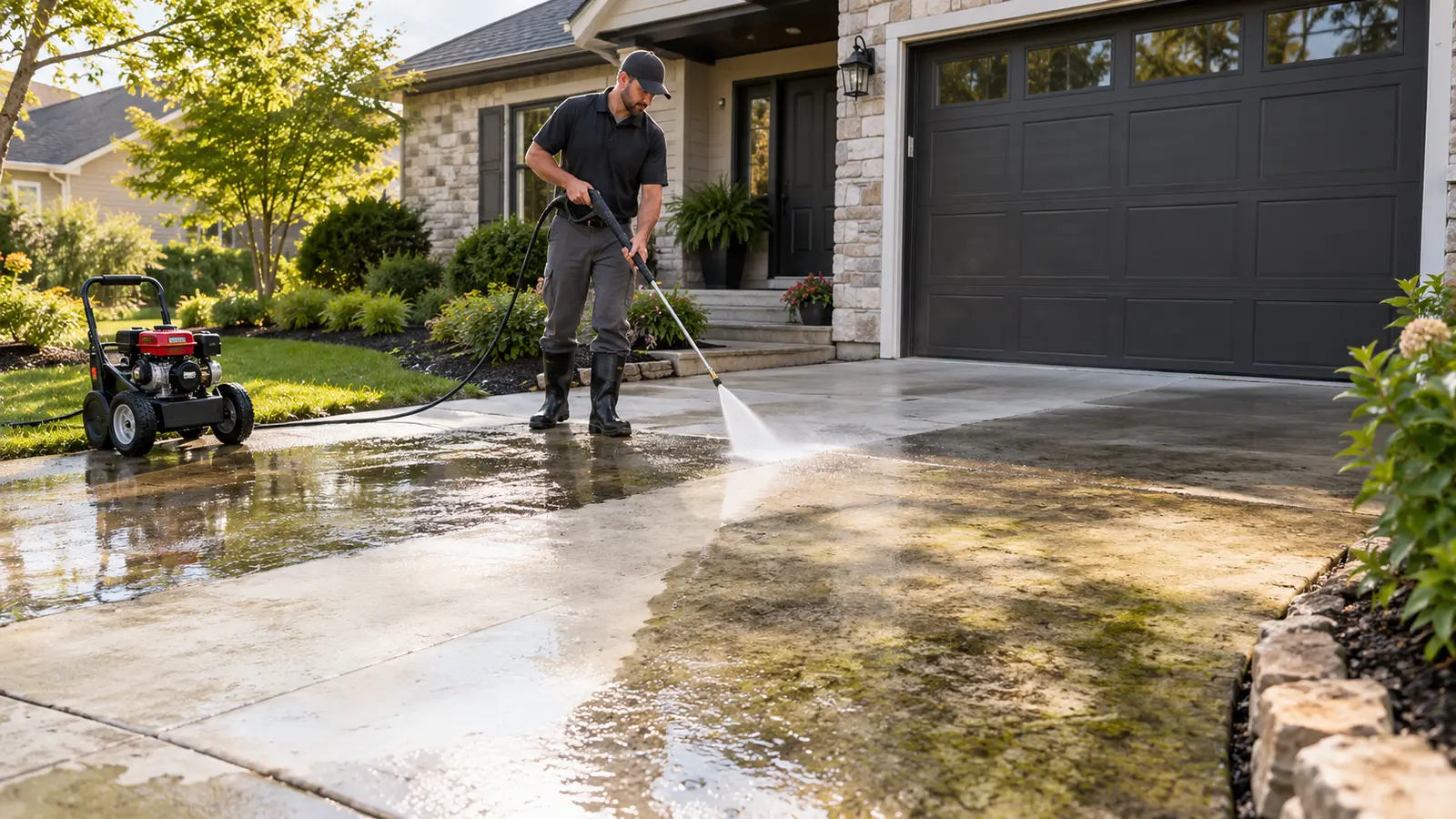
The right answer depends on your specific property: its exposure, tree cover, the surfaces you have, and how quickly biological growth returns after cleaning. For most St. Louis County homes, annual service for driveways and hard surfaces and a house wash every one to two years for siding keeps your exterior in good condition without over-spending. Here is how to assess what your property actually needs.
What Is the General Rule for Power Washing Frequency?
The industry standard recommendation for most homes in humid climates like St. Louis County is annual power washing of concrete and hard exterior surfaces, and a professional house wash (soft wash) every one to two years for siding and painted walls. These intervals are starting points, not rigid schedules. A home in full sun with minimal tree cover may look clean two seasons after a washing. A home under mature oak and elm trees with a north-facing wall may show visible algae growth within six months. Adjust your schedule to what you actually see on your home rather than following a fixed calendar.
What Factors Make More Frequent Power Washing Necessary?
Several conditions accelerate contamination and shorten the time between necessary cleanings. Heavy tree canopy creates shade that keeps surfaces damp longer, which algae and mildew require to establish themselves. Irrigation systems that spray onto siding or hard surfaces deposit minerals and moisture that feed biological growth. Proximity to water features, retention ponds, or creek drainage creates additional humidity at ground level. North-facing walls receive less direct sun and dry more slowly after rain, making them consistently more prone to algae growth. If your property has any of these conditions, plan for annual service rather than biennial.
What Factors Can Extend Time Between Washings?
Properties with full sun exposure on all elevations, minimal tree coverage, no active irrigation spray near structures, and good drainage typically stay cleaner longer between professional cleanings. Using a quality exterior sealant on concrete driveways and patios after cleaning creates a surface that resists staining and slows the re-establishment of biological growth. Trimming trees and shrubs away from the house exterior reduces the organic material that lands on siding and feeds mold and algae.
What Are the Signs Your Home Needs Power Washing Now?
Visible green or black streaking on siding, particularly under eaves and on north-facing walls, is the clearest sign that biological growth has taken hold. Concrete that has shifted from its original light gray to a dark or greenish color indicates algae and mildew. Oil stains on the driveway, mold on deck boards, and general dinginess that is visible from the street all indicate that cleaning is overdue. Do not wait until the contamination is severe; biological growth bonds more firmly to surfaces over time and becomes harder to remove with each additional season it is left in place.
What Is the Best Time of Year to Power Wash in St. Louis County?
Late spring (May through early June) and early fall (September through October) are the best windows for power washing in St. Louis County. Spring cleaning removes winter accumulation and prepares surfaces for outdoor summer use. Fall cleaning removes summer biological growth before winter embeds it further into surface pores. Schedule exterior cleaning with Andy's Window Cleaning for power washing and house washing services throughout St. Louis County, MO.
FREQUENTLY ASKED QUESTIONS
For most homes in St. Louis County, an annual power washing of hard exterior surfaces like driveways, patios, and decks is the standard recommendation. House siding typically benefits from a professional house wash (soft wash) every one to two years. Properties in shaded areas, near trees, with irrigation systems, or in humid microclimates may need more frequent service because biological growth establishes itself faster in those conditions. Rather than following a fixed calendar, watch for visible signs of algae, mildew, or heavy staining and schedule service when they appear.
Clear signs that your home needs exterior cleaning include green or black streaking on siding or concrete, visible algae or mildew growth on walls or under eaves, oil stains on the driveway, mold or mildew on the deck surface, dingy or gray-looking concrete that was originally lighter in color, and caked-on dirt or debris along foundation walls. If your home has not been washed in more than two years, it almost certainly has significant biological growth in at least some areas even if it is not immediately obvious from the street.
Frequent power washing of concrete and brick at appropriate PSI settings does not cause damage in the way that improper high-pressure washing of siding does. However, excessive washing of wood decking can raise the wood grain over time if done at high pressure, and repeated soft washing of siding more than necessary is generally just an unnecessary expense rather than a risk. The greater danger is under-washing rather than over-washing: biological growth that goes unaddressed bonds more firmly to surfaces over time and becomes harder and more expensive to remove.
St. Louis County's humid subtropical climate with wet springs and warm summers creates near-ideal conditions for algae and mildew growth on exterior surfaces. Properties in areas with significant tree canopy and limited direct sun may see biological growth return within six months. Properties with full sun exposure on all walls and minimal tree cover may go two seasons without visible regrowth after a thorough cleaning. The presence of irrigation systems, proximity to water features, and the direction each wall faces all influence how quickly contamination returns to your specific property.
Yes, always. Surface preparation is the most important factor in how well exterior paint adheres and how long it lasts. Painting over dirt, algae, mildew, or loose material means the paint bonds to the contaminant rather than the surface, leading to peeling, flaking, and premature failure. A professional house wash followed by adequate drying time (typically 24 to 48 hours in St. Louis County's climate) removes biological growth and contaminants that would otherwise interfere with paint adhesion. Most professional painters require or strongly recommend exterior washing as part of their prep process.
For the majority of St. Louis County homes with concrete driveways, standard siding, and typical landscaping, one annual service is sufficient to maintain a clean appearance and prevent biological growth from establishing itself deeply. Homes with heavy tree coverage, persistent shade, irrigation systems, or previous seasons of neglected cleaning may need more frequent attention, at least initially, to clear the accumulated growth. Once a property has been brought to a clean baseline, annual maintenance is generally enough to keep it there.
Late spring, typically May or early June, is the most popular time for power washing in St. Louis County. By late spring, temperatures are warm enough for efficient drying, the worst of pollen season has passed, and the summer's biological growth has not yet had time to establish itself fully. Early fall, from September into October, is the second best window: summer growth is at its peak and can be removed before winter, and mild temperatures allow proper drying. Avoid scheduling power washing when freezing temperatures are forecast, as water in cracks and joints can cause damage when it freezes.