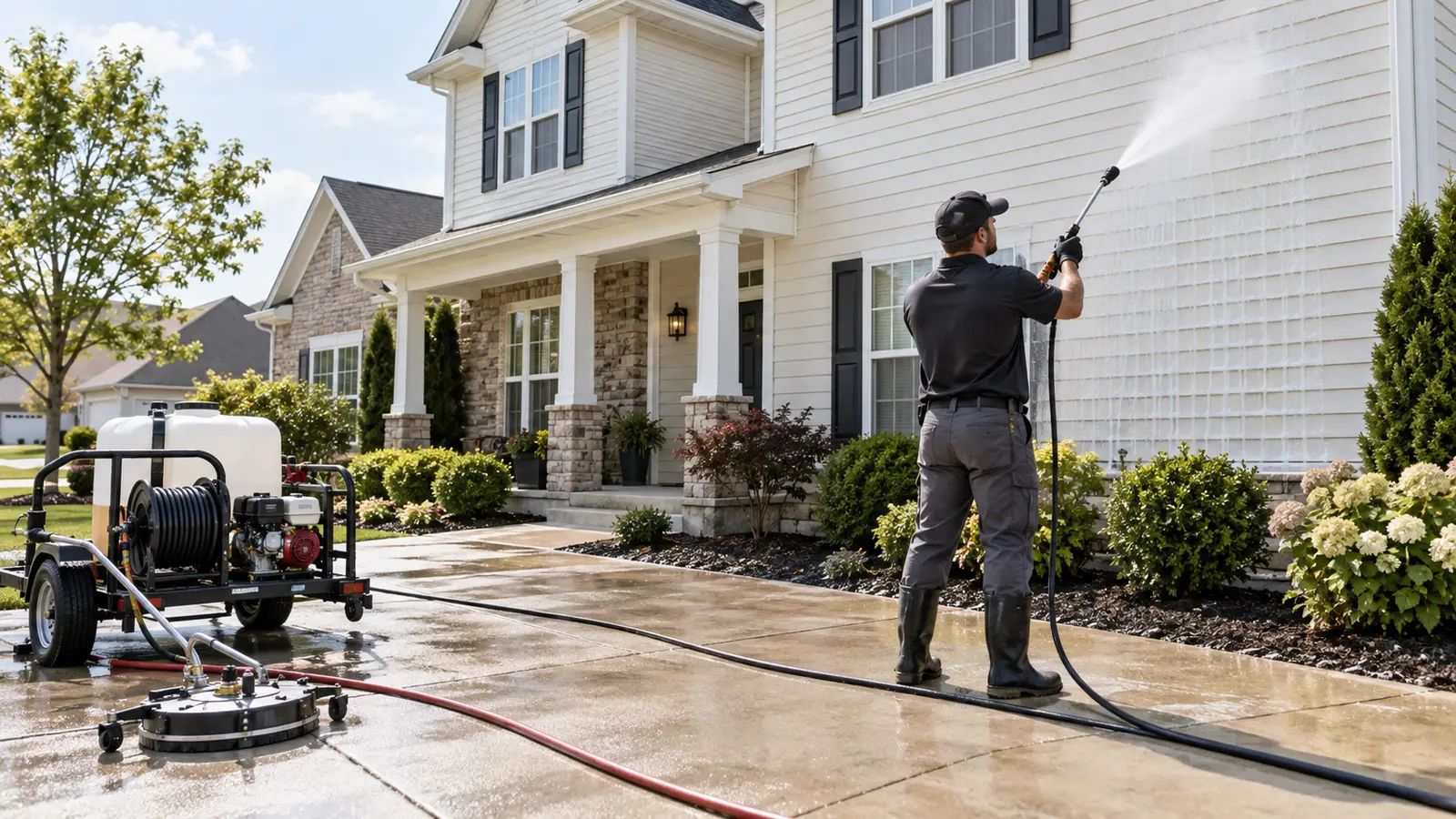
If you have looked at your home's driveway and siding and wondered which cleaning method you actually need, you are not alone. Many St. Louis County homeowners hear the terms interchangeably, but house washing and power washing are distinct services designed for different surfaces and different types of buildup. Choosing the right one protects your property from damage and gets you a cleaner result.
What Is the Core Difference Between House Washing and Power Washing?
Power washing uses water at high PSI to strip dirt and contaminants from hard, durable surfaces. The cleaning power comes primarily from the force of the water. House washing, also called soft washing, uses lower pressure and relies on biodegradable cleaning solution to do the heavy lifting. The chemistry loosens, kills, and lifts biological growth while a gentle rinse removes the material without stressing the surface. One method depends on water pressure; the other depends on chemical action. Both are effective, but only when matched to the right material.
When Is Power Washing the Right Choice?
Use power washing for hard, non-porous surfaces that can handle significant force: concrete driveways and sidewalks, brick retaining walls, stone patios, pool decks, and garage floors. These surfaces are dense enough to withstand high PSI without surface damage, and the force is necessary to remove deeply embedded stains, oil spots, tire marks, and years of accumulated grime. Power washing is also appropriate for wood decking when the pressure setting is carefully calibrated to the wood species and its current condition. Your technician assesses the surface before applying any water pressure.
When Is House Washing the Right Choice?
Use house washing for your home's vertical exterior surfaces: vinyl siding, painted wood, fiber cement, stucco, EIFS, aluminum, and brick facades. These materials, particularly older ones, cannot handle high-pressure water safely. High PSI directed at vinyl siding can crack or dislodge panels. Water forced behind siding creates moisture problems inside the wall cavity that lead to mold, rot, and structural damage over time. House washing applies cleaning solution at low pressure to remove algae, mildew, pollen, oxidation, and general grime from siding without any of those risks. The result is thorough cleaning that is also safe for the material.
Can One Property Need Both Services?
Yes, and many St. Louis County homes benefit from both in the same appointment. The exterior walls receive a house wash while the driveway, walkway, and patio receive power washing. Scheduling both together saves time, reduces setup costs, and ensures every exterior surface is addressed appropriately rather than treated with a one-size-fits-all approach. Our team can assess your entire property and recommend the right combination for each surface before any work begins.
What Are the Most Common Misconceptions?
Some homeowners assume more pressure always produces cleaner results. That assumption leads to damaged paint, cracked vinyl, and water intrusion behind siding. Others believe house washing is too gentle to be effective against heavy algae or mildew staining. In reality, the cleaning solutions used in professional soft washing eliminate algae and mildew more thoroughly than high-pressure water alone, because they kill the biological growth at its source rather than simply washing the visible surface layer away. The growth returns more slowly when the underlying spores have been neutralized rather than just rinsed.
Contact Andy's Window Cleaning to schedule power washing, house washing, or both for your St. Louis County property. Request a free quote and we will assess every surface before making a recommendation.
FREQUENTLY ASKED QUESTIONS
House washing uses low water pressure combined with biodegradable cleaning solution to safely clean siding, stucco, and painted surfaces. Power washing relies on high-pressure water to remove dirt and staining from hard, non-porous surfaces like concrete, brick, and stone. The two methods are designed for different materials, and using the wrong approach on the wrong surface can cause damage. House washing is the safe choice for vertical siding; power washing is appropriate for driveways, patios, and other hard horizontal surfaces.
Yes. High-pressure water directed at vinyl siding can crack or dislodge panels, force water behind the siding into the wall cavity, and strip caulking around windows and door frames. Professional technicians use lower pressure settings for vinyl and typically recommend soft washing for most siding applications. If you notice water staining on interior walls, warped drywall, or musty odors after a pressure washing job, water intrusion behind the siding may be the cause. A qualified technician assesses each surface before applying any pressure.
House washing costs vary based on the size of your home, the number of stories, and the degree of biological buildup present. A standard single-story home in St. Louis County typically ranges from $200 to $400. Two-story homes with greater surface area fall in the $350 to $600 range. Homes with heavy algae or mildew staining may require additional treatment time and solution. Andy's Window Cleaning provides free quotes so you know the exact cost before any service begins.
Most homes in St. Louis County benefit from a house wash every one to two years. Homes in shaded areas, near trees, or on north-facing lots where moisture stays longer may need annual washing because algae and mildew grow faster in those conditions. Visible green streaking, black staining on siding, or a chalky appearance on painted surfaces are signs a wash is overdue regardless of how much time has passed since the last service. Waiting too long allows biological growth to bond more firmly to the surface.
Professional house washing is safe for the vast majority of siding materials, including vinyl, painted wood, fiber cement, aluminum, and brick, provided the solution concentration and rinse pressure are matched to the specific material. Older painted wood and historic masonry require extra care to avoid disturbing original finishes. A professional assessment before washing identifies any areas that need special handling. DIY house washing with incorrect equipment or concentrated solutions can cause surface damage that proper professional technique avoids entirely.
Yes. Our technicians will work around items that cannot be moved, but clearing outdoor furniture, potted plants, and decorative objects from the work area makes the job faster and helps protect your belongings. We cover or relocate plants directly adjacent to treated areas and rinse surrounding landscaping after the cleaning to remove any solution that settles on leaves or soil. If large or heavy items cannot be moved before your appointment, let us know when you schedule so we can plan the job around them.
Consumer pressure washers available at hardware stores deliver less PSI than professional equipment and often lack the adjustability to dial in the right pressure for different surfaces. Incorrect pressure settings on the wrong surface cause damage that can be expensive to repair. For driveways and large concrete areas, a well-maintained consumer machine can be adequate when used carefully. For anything touching your home's siding, windows, or trim, professional service reduces risk and typically delivers better results because technicians bring surface-specific training, proper equipment, and appropriate cleaning solutions to every job.